


Sometimes diagnostics feels less like repair work…
and more like archaeology.
Tonight’s case:
2018 Ford Transit.
AdBlue warning.
“No engine restart in XX miles.”
Several garages had already been through the vehicle before I arrived.
The turbocharger had already been replaced — and rightly so.
After that… the guessing started.
Fault codes cleared.
Parts replaced.
Different theories.
But the one thing that remained:
that stubborn AdBlue warning.
I started at 6 PM.
Finished around midnight.
Step by step, live data by live data, we eliminated possibilities one by one.
First breakthrough:
the DPF inlet pressure sensor was lying badly.
With ignition on and engine off, it still showed pressure.
That alone can completely corrupt regeneration and SCR calculations.
Sensor replaced.
Regeneration completed successfully.
630°C regeneration temperature achieved.
DPF soot loading dropped to almost nothing.
Still…
that AdBlue warning stayed alive.
Then came the next rabbit hole:
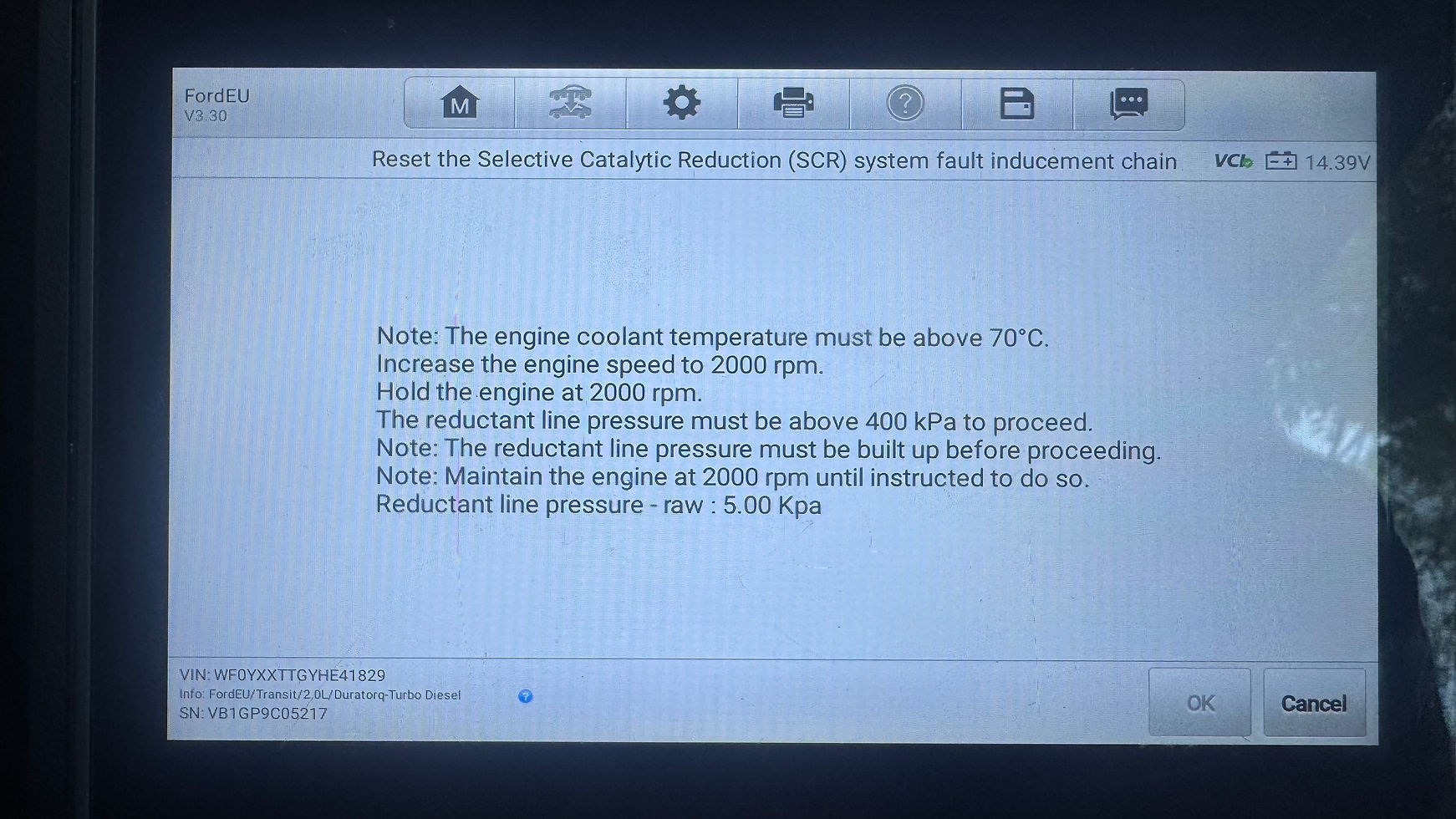
SCR pressure.
At first glance:
almost no pressure.
For a moment it looked like a dead AdBlue pump.
But diagnostics is dangerous when you stop thinking too early.
Under active testing, the system suddenly built a stable 500 kPa pressure perfectly.
So:
pump OK,
pressure sensor OK,
no major leak,
system alive.
And yet the countdown continued.
The motorway drive cycle began.
London traffic fighting us every mile.
The van beeping every couple of miles like a dying spacecraft.
Then finally…
the holy grail arrived:
P20EE – SCR NOx Catalyst Efficiency Below Threshold.
Not a wiring fault.
Not a dead pump.
Not a communication issue.
Efficiency.
And suddenly the whole story made sense.
Previous turbo failure likely contaminated the combined DOC/DPF/SCR unit over time with oil ash and soot loading.
The system technically works…
but the NOx conversion efficiency is no longer good enough for the ECU.
Before condemning the entire catalyst assembly, there is still one final suspect:
the AdBlue injector itself.
Pressure is correct.
But spray pattern and atomisation may not be.
And this is exactly why proper diagnostics matters.
Not because fault codes exist.
But because understanding WHY they exist is what separates diagnosis from parts darts.
Midnight.
Cold motorway.
One warning light.
And finally…
the truth.

Comments